• Home
  • About
  • Author
  • Reviews
  • Media/Events
  • Contact

The Making of Markova

~ by Tina Sutton

         The Making of Markova

Tag Archives: The Firebird

Mastering Stravinsky: Markova’s Rite of Passage

23 Monday Sep 2013

Posted by Tina Sutton in Uncategorized

≈ 3 Comments

Tags

Alicia Markova, American Ballet Theatre, Ballet of the Elephants, Ballets Russes, Bronislava Nijinska, Circus and the City: New York 1793-2010, Discovery.com, George Balanchine, George Benjamin, Henri Matisse, Igor Stravinsky, Matthew Wittman, Picasso, RIngling Bros. and Barnum & Bailey Circus, Sergei Diaghilev, The Firebird, The Jewish Museum, The Rite of Spring, Vaslav Nijinsky, Vera Stravinsky

Stravinsky & Nijinsky shocked the world with The Rite of Spring

Stravinsky & Nijinsky shocked the world with The Rite of Spring

No one said breakthrough art is easy, either for the creator or the initial audience. When Igor Stravinsky composed The Rite of Spring (Le Sacré de Printemps) for the Ballets Russes 100 years ago, it spearheaded a revolution in contemporary music – and a revolt in the theatre. Ballet patrons physically rioted when faced with the cacophonous score accompanying Vaslav Nijinsky’s equally provocative choreography. Though police were called in, impresario Sergei Diaghilev couldn’t have been happier. The more his ballet company shocked, the more press he got, and the more tickets he sold.

“No composer since can avoid the shadow of this great icon of the 20th century, and score after score by modern masters would be unthinkable without its model,” British composer George Benjamin wrote of Stravinsky in The Guardian this past May. “This, in a way, is cubist music – where musical materials slice into one another, interact and superimpose with the most brutal edges, thus challenging the musical perspective and logic that had dominated European ears for centuries.”

Picasso's cubist cardboard costume for Parade (1917)

Picasso’s cubist cardboard costume for Parade (1917)

Diaghilev was a genius at choosing artists who challenged the status quo. Who but the avant-garde Russian would have asked Picasso to create cubist ballet costumes – out of stiff cardboard no less!

A surreal Bronislava Nijinska at the Ballets Russes

A surreal Bronislava Nijinska at the Ballets Russes

– or applaud Bronislava Nijinska’s startling surrealist make-up for Léonide Massine’s Kikimora in 1917?

When Diaghilev invited Alicia Markova to join the Ballets Russes as its youngest-ever soloist in 1923, she was a shy, unsophisticated 14-year-old. (See photo below.)

Alicia Markova at age 14, the newest member of the Ballets Russes (1923)

Alicia Markova at age 14, the newest member of the Ballets Russes (1924)

Her first starring role was in Le Chant de Rossignol (The Song of the Nightingale), with choreography by George Balanchine – his first major commission for Diaghilev – and music by Igor Stravinsky. While the tiny dance prodigy had no problems mastering Balanchine’s complicated and supremely athletic dance sequences, Stravinsky’s music was another matter. As Markova reminisced in The Making of Markova: I remember the very first rehearsal with Balanchine. I started to cry and they said what’s the matter? I said I’m never going to be able to learn this. You know, this isn’t music to me. What am I to do? And Stravinsky was so wonderful. . . . He said, “There’s no worry. I’ll be there for all the rehearsals, and I will conduct, [unheard of for the celebrated composer!] and as long as I’m here, you mustn’t worry, but there’s one thing you have to promise me . . . You’ve got to learn the scores by ear. You must learn the instrumentation, orchestration and everything by ear,” he said, “and then you’ll never have any worry for the rest of your life.” And he was so right.

Markova's star-maker Sergei Diaghilev, with her music teacher Igor Stravinsky

Markova’s star-maker Sergei Diaghilev, with her music teacher Igor Stravinsky

Not only did Stravinsky become Markova’s music instructor, but he accompanied her, Diaghilev, and Henri Matisse (the lucky Alicia’s art teacher!) to the studio of Nightingale costumier (and former ballet dancer) Vera de Bosset Soudeikine, who incidentally, would become Stravinsky’s second wife. Matisse was responsible for Markova’s costume design, with Mme. Soudeikine charged with bringing his creation to life.

Stravinsky happily married to  second wife Vera Soudekina, both subjects of a fascinating new play Nikolai and the Others at Lincoln Center last spring

Stravinsky happily married to second wife Vera de Bosset Soudeikine, both subjects (along with Balanchine), of Richard Nelson’s fascinating play Nikolai and the Others, performed at Lincoln Center last spring.

When Matisse announced his plan to cover Markova’s little girl hair bob with a white bonnet trimmed in osprey feathers – an extravagantly expensive trim – the budget-minded Diaghilev emphatically cried ‘No!” As Markova finishes the story in The Making of Markova: But please Sergevitch,” pleaded Matisse, “the little one needs them round her face to soften the hard line of the bonnet and make her a little bird,” protested Matisse. “No ospreys,” repeated Diaghilev. Then Stravinsky entered the argument. He too thought they were necessary, but Diaghilev was adamant and refused, and unexpectedly Stravinsky turned to Matisse and said, “Henri, we buy the ospreys between us, 50-50, yes?” “Yes!” echoed Matisse, and so I had my ospreys, and how I guarded them, as if they were gold.
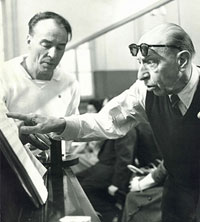
Balanchine and Stravinsky collaborated on a gargantuan task 1942 . . .

Balanchine and Stravinsky collaborated on a gargantuan task 1942 . . .

While Markova never again had trouble with Stravinsky’s unique musical phrasing, others were not so lucky, as when the composer collaborated again with Balanchine in New York in 1942. The mystified dancers? Pachyderms at the Ringling Bros. and Barnum & Bailey Circus! As Matthew Wittman explained in Circus and the City: New York 1793-2010: “‘The Ballet of the Elephants’ production was an attempt by John Ringling North to bring high culture into the circus and featured fifty elephants in pink tutus accompanied by female dancers. The rhythm changes in Stravinsky’s Circus Polka proved difficult for the elephants to grasp, and it was only performed intermittently.”

Apparently circus elephants do forget when it comes to dancing to Stravinsky

Apparently circus elephants do forget when it comes to dancing to Stravinsky

Evidently pigeons and songbirds don’t care much for Stravinsky’s dissonant compositions either, according to a research study posted on Discovery.com. The classical cadences of Bach are more to their liking. Fish, it appears, are musically non-judgmental – if listening to either composer’s music results in more food.

The very human Markova, however, was an ardent and vocal Stravinsky fan – of both the man and his exhilarating music. The two remained lifelong friends and visited each other often in the United States where Stravinsky moved with Vera during World War II.

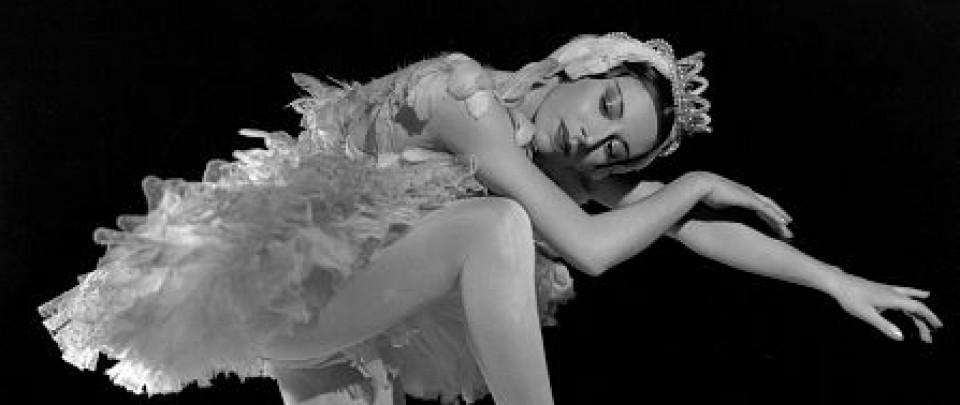
In 1945, Markova starred in The Firebird at Ballet Theatre, with music by Stravinsky,

Markova starred in The Firebird at Ballet Theatre (1945), with music by Stravinsky

Markova asked Stravinsky to compose music for her Broadway debut – to which he happily consented – and she delighted starring at the Ballet Theatre (today’s American Ballet Theatre) in the 1945 revival of The Firebird, the composer’s first commission for the Ballets Russes back in 1910. (Though Michel Fokine choreographed the ballet for Anna Pavlova, she refused the role proclaiming Stravinsky’s music “noise!”) Marc Chagall (currently the subject of a illuminating new exhibit at The Jewish Museum in New York) designed Markova’s breathtaking Firebird costume, which was covered in shimmering gold dust and topped with a dramatic headdress of bird of paradise feathers. One wonders if osprey plumes were still just too expensive!

Share this:

  • Tweet
  • Click to email a link to a friend (Opens in new window) Email
  • More
  • Share on Tumblr
Like Loading...

The Colorful Marc Chagall

14 Sunday Apr 2013

Posted by Tina Sutton in Uncategorized

≈ 2 Comments

Tags

Aleko, Alicia Markova, American Ballet Theatre, Chagall: Beyond Color, Dallas Museum of Art, Leonide Massine, Marc Chagall, The Firebird

Marc Chagall's drawing of Alicia Markova for the ballet Aleko

Marc Chagall’s drawing of Alicia Markova for the ballet Aleko

Though I can’t dance a step, I did share one thing with Alicia Markova: a lifelong love of art and art history. So when researching her biography, I relished exploring Markova’s numerous personal relationships with many of the most cutting-edge modernists of her day. She developed an especially close bond and friendship with the Russian painter Marc Chagall, whom Time magazine art critic Robert Hughes called “the quintessential Jewish artist of the 20th century.”

Markova and Chagall shared not only a religion – both Jews in vehemently anti-Semitic times – but also an immense joy in their art, evidence of which is now on display in the Dallas Museum of Art’s irresistible show: Chagall: Beyond Color. For the first time since the 1940s, Chagall’s glorious sets and costumes from the ballet “Aleko” – choreographed by Léonide Massine and starring Alicia Markova – are on public view in the United States.

Chagall exhibit at Dallas Museum of Art

Chagall exhibit at Dallas Museum of Art

When the ballet premiered in Mexico City in 1942, Chagall’s ebullient designs were so bold and original that celebrated artists Diego Rivera, Frida Kahlo and José Orozco gave him a standing ovation on opening night. (The ballet received 19 curtain calls, with Chagall invited up on stage to take his well-deserved bow with the dancers.)

How did Marc Chagall wind up in Mexico? Forced to flee Paris with his family due to Nazi persecution during World War II, the renowned painter moved to New York when propitiously invited by the city’s acclaimed Museum of Modern Art. It was there, while working for Ballet Theatre (now the American Ballet Theatre), that fellow Russian Léonide Massine asked Chagall to collaborate with him on “Aleko” – a tragic tale of passionate love and betrayal based on a poem by another famous Russian, Alexander Pushkin. Fortunately that creative process took place during a spring/summer performance booking in Mexico City, because the New York stage painters union would not have permitted Chagall to do anything but “direct” the design process if they had been working in Manhattan.

One of Chagall's 30 x 40 foot hand-painted ballet set backdrops for Aleko

One of Chagall’s 30 x 40 foot hand-painted ballet set backdrops for Aleko

Chagall's fish costume for Aleko

Chagall’s fish costume for Aleko

That would have been a tremendous loss, as you can see here in photos of several extraordinary Aleko pieces in the Dallas show. Chagall’s four hand-painted backdrops (30 by 48 feet each!) boasted his signature folkloric symbolism, spontaneity of brushstroke, and remarkable eye for intense, expressive color. The artist also hand-painted the wildly inventive costumes, almost 70 in all, each with its own distinct flavor of delicious colorations and whimsical design.

Chagall violin costume for Aleko

Chagall violin costume for Aleko

Markova spent much time working and socializing with Chagall and his beloved wife Bella during the entire creative process for Aleko. The trio would shop the city’s marketplace together, gathering inspiration from the intense local colors as they scooped up vibrantly dyed fabrics and intricate decorative trims. Bella, an excellent seamstress, would then stitch the various materials together under her husband’s direction as he experimented with fanciful layering. Markova also contributed, making exotic armlets and necklaces for her costumes from decorative Mexican gold coins.

Markova as Aleko's Zemphira in a costume designed by Marc Chagall

Markova as Aleko’s gypsy Zemphira, costume design by Marc Chagall

As the firey gypsy temptress Zemphira, Markova had numerous costume changes, one more exotic than the next, and all covered in layered nettings, fabric flourishes and colorful appliqués. Chagall hand-painted each garment while Markova modeled it, so he could achieve the perfect placement for his symbolic design details.

Best known as an exquisitely refined and ethereal classical ballerina – the quintessential Giselle – Markova was a revelation to critics and audiences alike as the perfect embodiment of a “priestess of evil,” as one critic remarked. Chagall’s costumes went a long way in helping Markova create that acclaimed performance, as dance critic Grace Roberts described:  

Chagall hand-painted Markova's costume while she modeled it

Chagall hand-painted this costume while Markova modeled it for him

With sunburnt make-up, wild hair, and a vivid red costume, her very appearance was a shock, though a delightful one. Nothing was left of the familiar Markova but the thistledown lightness, and authoritative dancing style, now turned to the uses of demi-caractère.

On the bodice of Markova’s first costume (photo at left), Chagall painted a small red heart just below the ballerina’s own, with a tree of life beneath it to illustrate the initial hopefulness of passionate love.

Ever after, Chagall signed all his correspondences to Markova with his name inside a heart – not as a token of romantic love – but as a reminder of their happy times working together. The pair would reunite in 1945 for the The Firebird ballet with music by Igor Stravinsky, once again with Markova dancing the lead role.

Chagall's  study for The Firebird ballet curtain

Chagall’s study for The Firebird ballet curtain

As in the study above for The Firebird ballet curtain (also in the Chagall: Beyond Color show in Dallas) the artist whimsically melds the spirit of Markova and the titled bird, both capable of effortless flight. In addition to creating a breathtaking costume for Markova with large beak and real bird-of-paradise plumes, Chagall developed a special body make-up for his fine feathered friend. First a dark brown body-wash was applied to Markova’s shoulders, arms, and back, followed by patches of grease. Gold-dust was then sprinkled all over her (or thrown at her, as she liked to say) sticking to any oily surfaces. While dancing the role, Markova’s body glistened like a bird’s feathers in the sun.

Markova and Chagall in 1967

Markova and Chagall in 1967

Though a magical effect, it took hours in a hot tub to soak off, forcing Markova to leave the theatre many an evening still covered in itchy gold dust. But she said it was always worth it, and she and Chagall remained great friends for life.

Share this:

  • Tweet
  • Click to email a link to a friend (Opens in new window) Email
  • More
  • Share on Tumblr
Like Loading...

Order on Amazon

  • Order from Barnes & Noble
  • Order from IndieBound
    • Write to Tina

    Archives

    • October 2014
    • August 2014
    • June 2014
    • May 2014
    • April 2014
    • March 2014
    • February 2014
    • January 2014
    • December 2013
    • November 2013
    • October 2013
    • September 2013
    • August 2013
    • July 2013
    • June 2013
    • May 2013
    • April 2013
    • March 2013

    Enter your email address to follow this blog and receive notifications of new posts by email.

    Join 33 other subscribers

    Blog at WordPress.com.

    • Subscribe Subscribed
      • The Making of Markova
      • Join 33 other subscribers
      • Already have a WordPress.com account? Log in now.
      • The Making of Markova
      • Subscribe Subscribed
      • Sign up
      • Log in
      • Report this content
      • View site in Reader
      • Manage subscriptions
      • Collapse this bar
     

    Loading Comments...
     

      %d